Payments observability · agents that close the breaks

Every dollar, explained. Continuously.

Artemis connects to your PSP, books, and bank, normalizes every money movement into one evidence spine, and answers the three questions platform finance teams ask every day: Are we whole? What’s broken — and who fixes it? What do I tell this seller? Then its agents chase the missing evidence, close the explainable breaks, and recover the money — inside a policy you set.

Provider-neutral by design: every workflow runs on canonical, normalized evidence — never on one PSP’s objects. Multi-PSP support spans Stripe, Adyen, and more through a shared adapter layer. Start with one read-only key.
Connect
A read-only PSP key first. Books and bank light up the moment you connect them.
Normalize
Every event becomes a canonical money movement with lineage back to source.
Reconcile
Deterministic tie-outs and payout verdicts. Waiting is calm; broken is loud.
Close
Agents chase evidence, close explainable breaks, and recover money — under policy.

Three questions, answered continuously.

Reconciliation tools hand you a spreadsheet of breaks at month-end. Artemis is the always-on answer layer for marketplaces, PayFacs, and embedded payments — and when the answer is “not whole,” its agents go get the evidence or the money.

01 / Are you whole?

One number, defended by evidence.

Stripe balance, internal books, and bank cash tied out continuously. Every dollar of variance is explained — in transit, waiting on schedule, or recovery exposure — or flagged as unexplained. Artemis never claims you’re whole on missing or stale evidence.

02 / What’s broken — and who fixes it

Most breaks close themselves.

Missing evidence gets chased at the source. Explainable breaks close with cited proof. Recoverable money gets recovered. Every close is stamped with who closed it — and your team only sees the judgment calls.

03 / Answer any seller

Seller questions in sixty seconds.

“Where is my payout?” becomes a full waterfall: gross, fees, refunds, reserves, recoveries, payout timeline — plus a plain-English, evidence-cited explanation you can paste into support. With honest boundaries where evidence ends.

The product, running.

Screens below are from a live Artemis environment — real evidence spine, real tie-outs, real autonomous closes. Honest states included: stale feeds and degraded legs are shown, never hidden. That is the point.

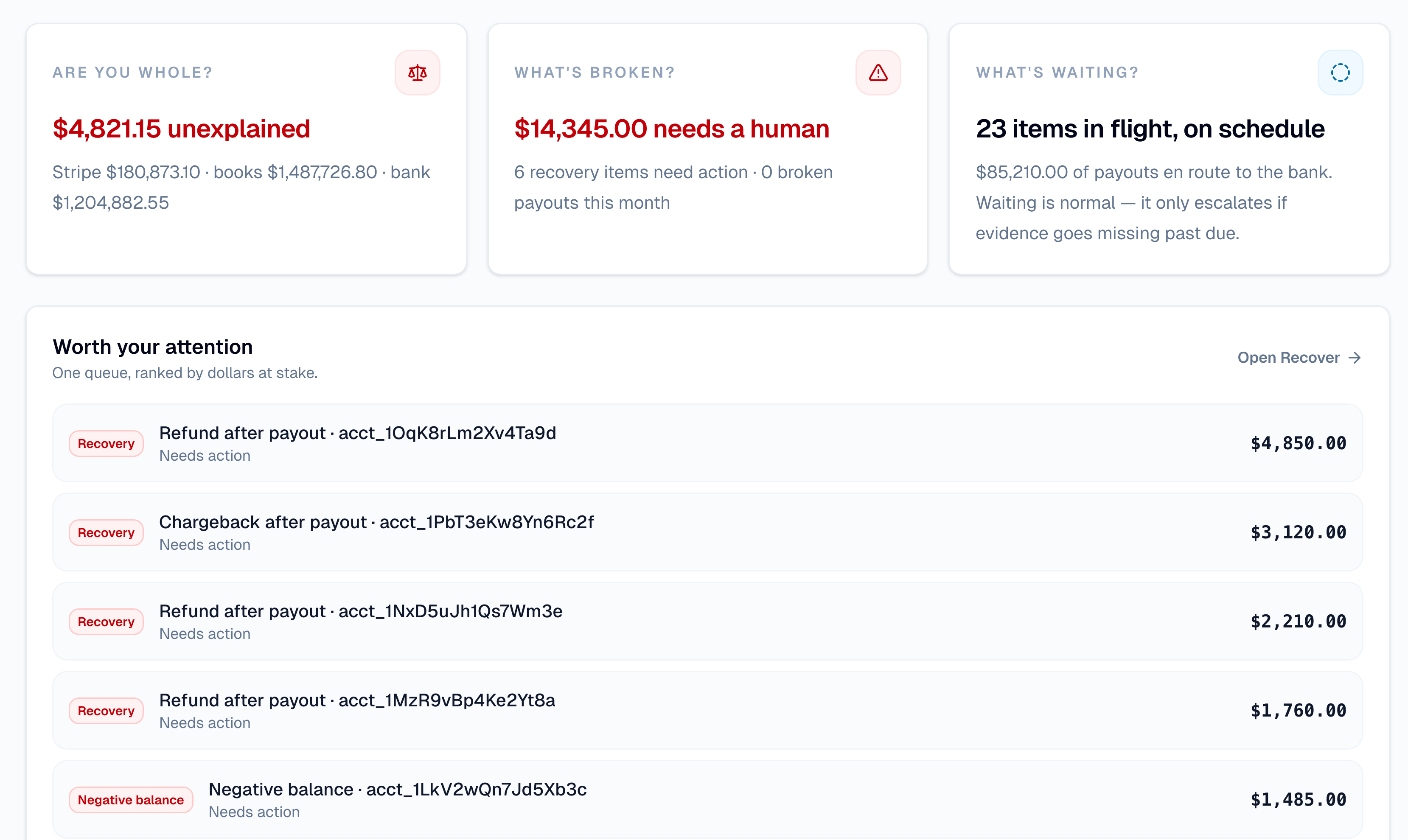
Artemis home answering: are you whole, what is broken, what is waiting — with a dollar-ranked recovery queue

The answers, not the archaeology.

Are you whole, what’s broken, what’s waiting — with one queue ranked by dollars at stake. Waiting money stays calm; only past-due or contradicted evidence escalates.

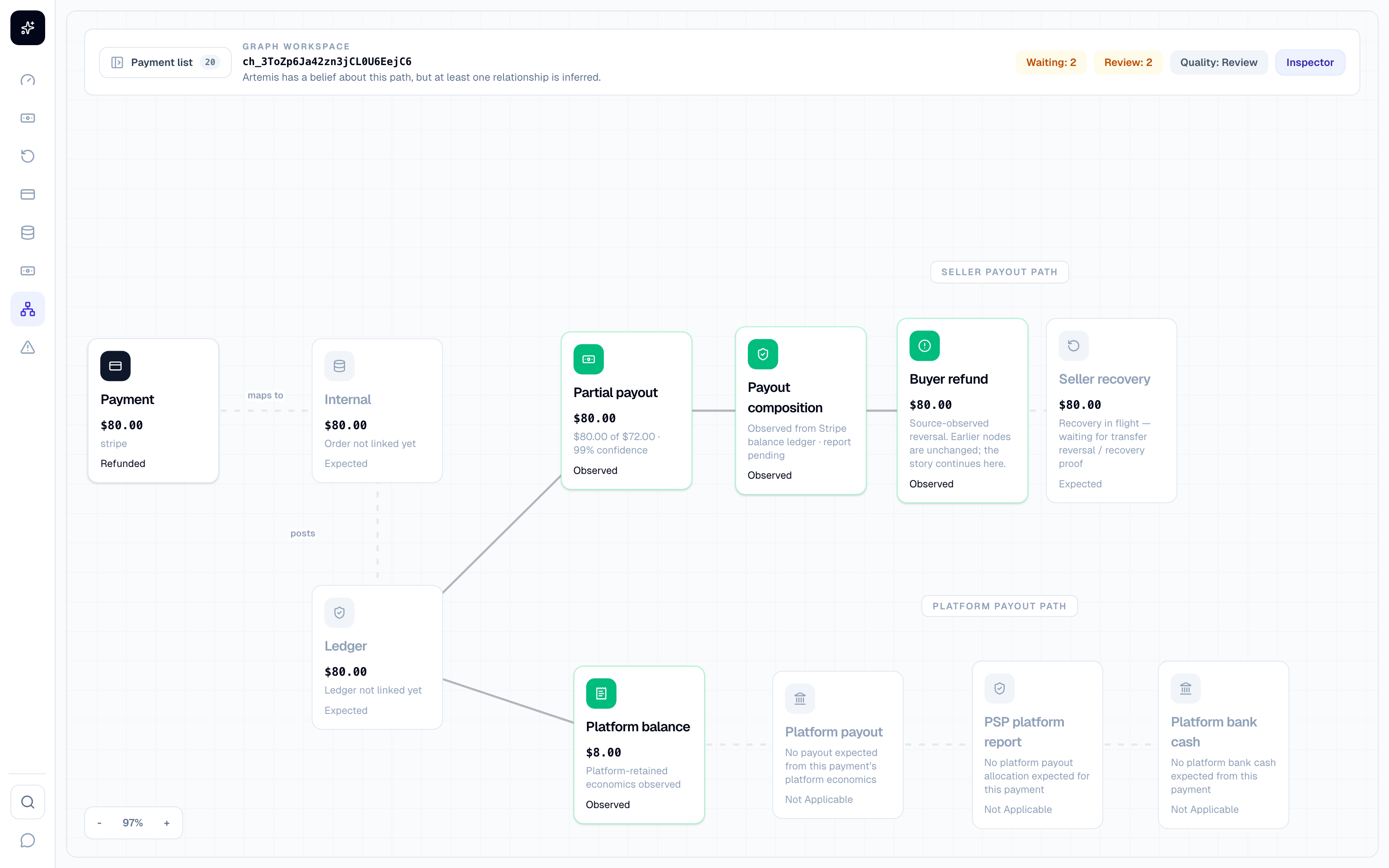
Artemis trace graph: a refund story from payment through payout composition, buyer refund, and seller recovery in flight

Trace any dollar through the evidence graph.

A real refund story: payment → payout composition → buyer refund → seller recovery in flight. Placed nodes are immutable — new evidence only ever appends to the right, and observed, expected, and not-applicable states stay visibly distinct.

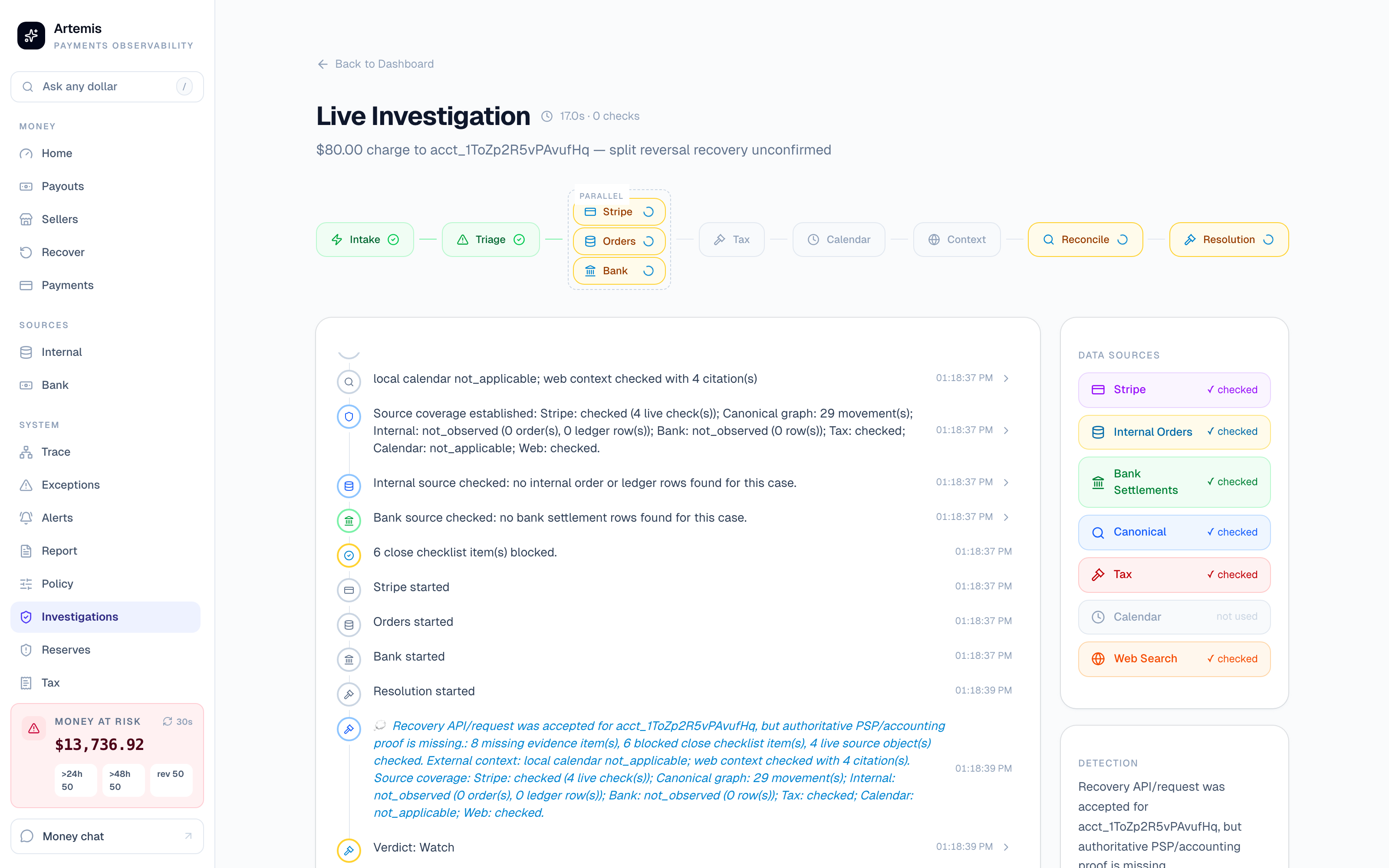
Artemis live investigation: parallel Stripe, Orders, and Bank agents establishing source coverage and reaching an honest verdict

Watch the agents investigate.

Parallel Stripe, Orders, and Bank agents establish source coverage, run the deterministic playbook, and reach an honest verdict — here: watch, recovery submitted, authoritative proof still missing. Every step and citation is on the timeline.

Agents where judgment lives, determinism where money math lives

Breaks stop waiting for a human.

Most reconciliation exceptions are not judgment calls — they are missing evidence, timing, or a clawback nobody executed. Artemis chases the evidence at the source, closes explainable breaks with cited proof, and executes source-backed recoveries through the same guarded rail as the button in the queue.

Everything runs inside a visible policy: confidence floors, amount caps, daily budgets, one-shot execution guards, a kill switch. Above the bounds, Artemis proposes and a human confirms. And API success is never treated as close proof — the loop closes only when source evidence lands.

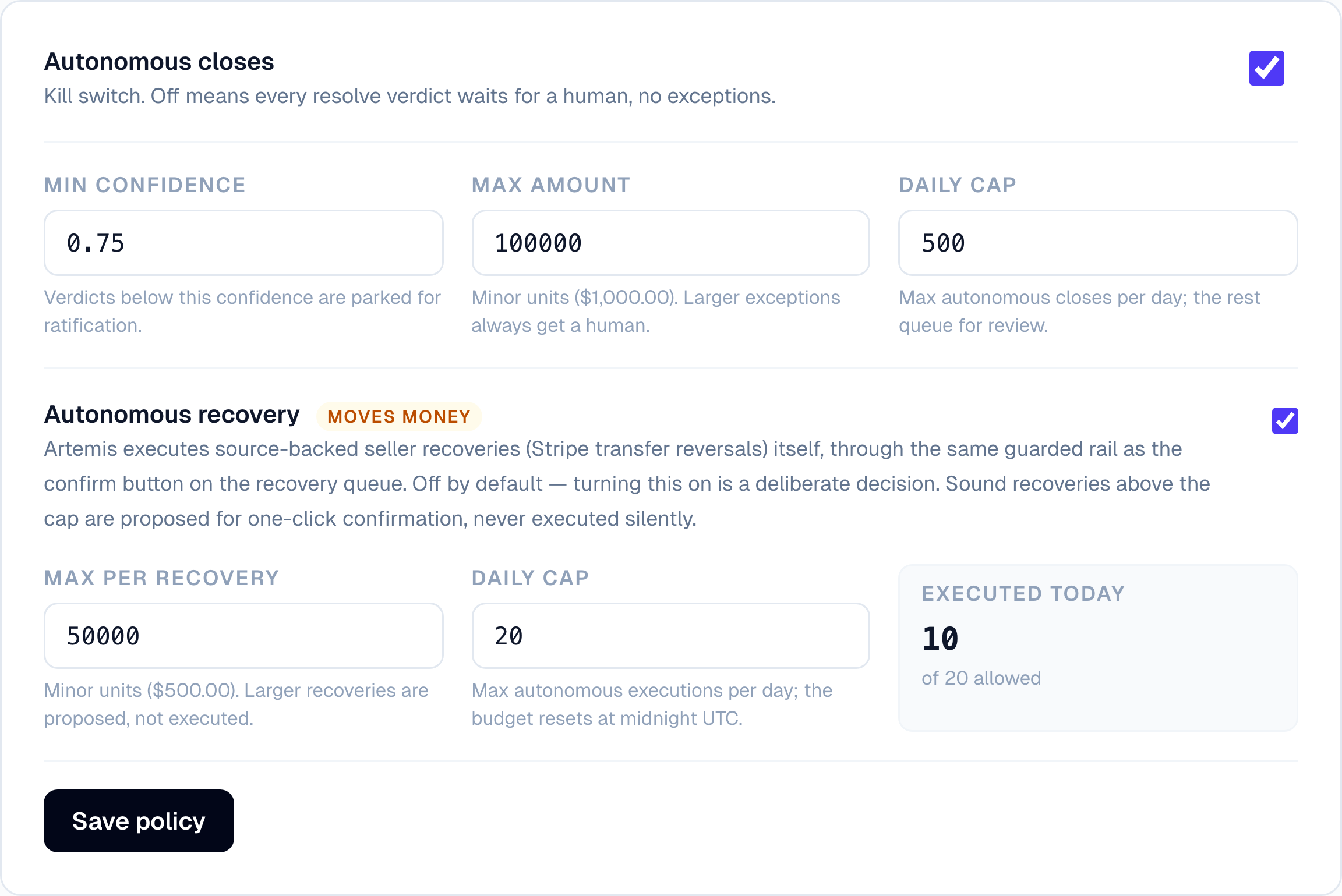
Artemis close policy: autonomous closes and money-moving recovery bounds with kill switch and executed-today counter

The policy page, verbatim.

Confidence floor, amount caps, daily budgets, a kill switch — and a “moves money” toggle that stays off until you decide otherwise.

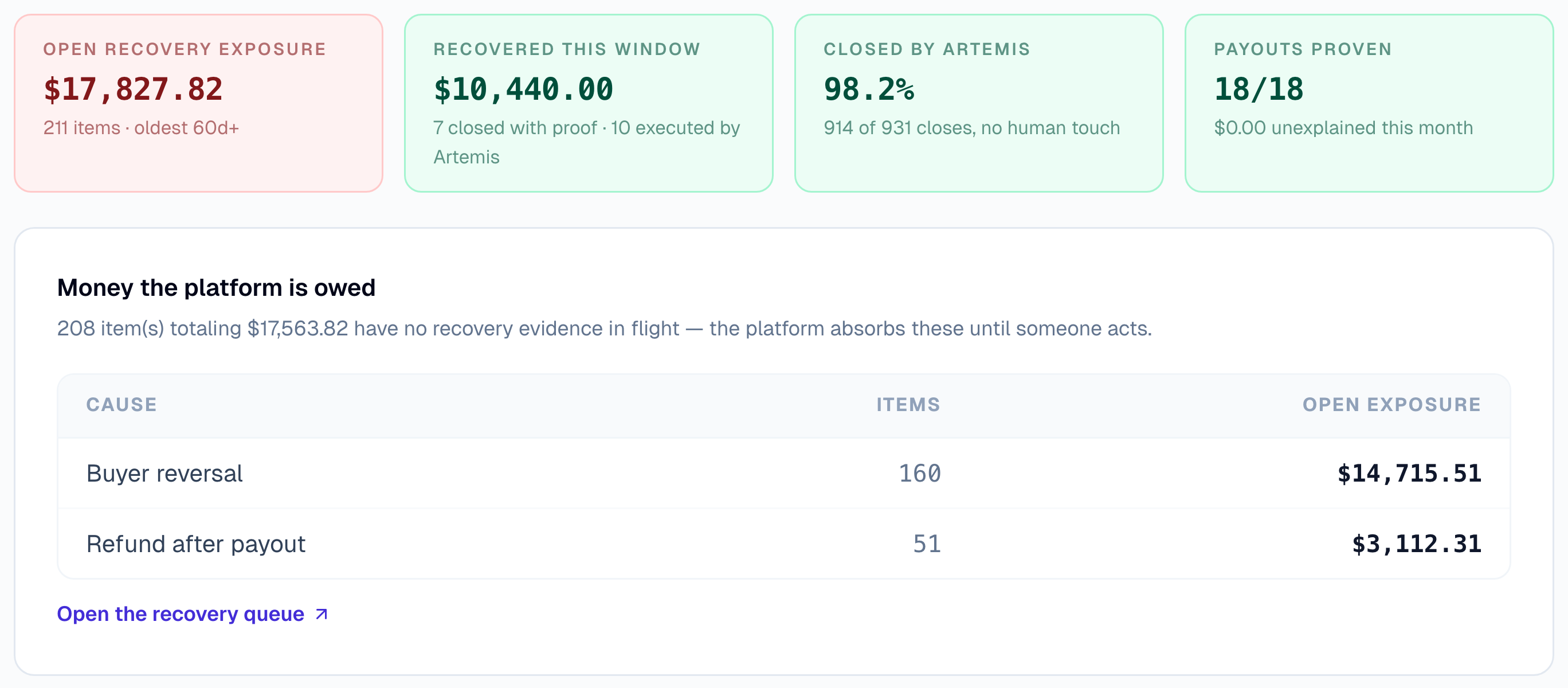
Artemis findings report: open recovery exposure by cause, dollars recovered with proof, and the autonomous close rate

What Artemis found — and closed.

The recurring readout for your ops review: open exposure by cause and age, dollars recovered with proof, and every close attributed to who closed it — evidence, Artemis, or a human. Printable for the month-end pack.

The payments truth layer

AI that finance teams can actually trust.

Artemis keeps raw payloads, canonical entities, reconciliation links, and inferred matches separate. Agents reason and act across messy money movement without ever pretending an inference is source truth — and without ever inventing a number that is not in the evidence.

Source truth
PSP objects, reports, and balance evidence; internal ledgers and order feeds; bank transactions via Plaid and statement files — all normalized into one provider-neutral canonical layer. Multi-PSP support spans Stripe, Adyen, and more through adapters against that contract.
Canonical layer
Charges, fees, transfers, payouts, refunds, disputes, reserves, adjustments, bank transactions, and internal orders — every one with lineage back to its source record.
Deterministic recon
Exact links, payout composition verdicts, three-way cash tie-out, timing-aware waiting-vs-broken states, and confidence that is earned, not asserted.
Autonomous close
Evidence chased at the source, explainable breaks closed with citations, recoveries executed under policy — and every close stamped with who closed it: evidence, Artemis, or a human.

The reconciliation wedge for the platform economy.

Marketplaces and PayFacs do not have simple bank-to-ledger matching problems. They have split payments, seller liabilities, payout timing gaps, processor fees, reserves, disputes, refunds, and month-end close pressure — all at once.

Marketplace payout recon

Show which charges, refunds, fees, disputes, reserves, and adjustments created every seller payout — with source-backed and inferred composition clearly separated, and a verdict on every payout.

PayFac liability recovery

Refund-after-payout, chargeback-after-payout, negative merchant balances, and unrecovered seller debt — found, dollar-ranked, aged, and recovered under policy instead of absorbed silently.

Embedded payments close

Tie processor activity, internal balances, bank cash, and settlement evidence into close-ready cases — with a findings report your controller can put in the month-end pack.

Seller support deflection

Turn “where is my payout?” tickets from hours of archaeology into a sixty-second, evidence-cited answer — with the honest boundary stated when the trail leaves your evidence.

Built by payment infrastructure operators
From the inside of global payments.

Two Adyen operators who worked inside marketplace payments and embedded finance saw the same pattern everywhere: money movement is becoming more fragmented, more multi-party, and harder to observe with legacy reconciliation tooling. Artemis is the observability layer they built to change that.

Overlay first. Replace nothing on day one.

Artemis runs alongside whatever you have today — spreadsheets, scripts, or a recon tool. Connect a read-only key and it builds its own picture from source evidence, runs its own queue, and shows you what it found and closed. No migration, no rip-and-replace bet, no six-week implementation before value.

Connecting many sources and normalizing them is the product, not a feature: PSPs, banks, ledgers, and product databases all resolve into the same canonical money movements, so every workflow — tie-outs, verdicts, recovery, autonomous close — is provider-neutral by construction. Multi-PSP support spans Stripe, Adyen, and more through adapters, not platform rewrites. Banks connect via Plaid or statement files; ledgers and databases via feeds and imports.

Multi-PSP supportStripeAdyenMore PSPs via adaptersPlaid — liveBank statement files — liveInternal ledgers & DBs — liveSlack alerts — liveWebhooksReportsAPIs
A category-defining opportunity, grounded in controls.

Artemis is not a generic accounting tool or a chatbot over finance data. It is AI-native payments observability: deterministic where money math lives, agentic where judgment lives, and evidence-backed everywhere.

Controls before conclusions.

Exact IDs, amount logic, lifecycle state, and payout composition come before probabilistic analysis or AI explanation. No number leaves the system without evidence behind it.

Evidence hierarchy stays visible.

Source truth, deterministic matches, inferred candidates, and human approval are never collapsed into one vague answer.

Waiting is not broken.

Normal settlement delays stay calm. Artemis escalates only when evidence is past due or contradicted — and never claims you are whole on missing or stale feeds.

Autonomy inside a visible policy.

Agents act within confidence floors, amount caps, daily budgets, and one-shot guards you can read on one page — with a kill switch, and a human confirmation above the bounds.

See your unrecovered dollars in two weeks.

Connect one read-only PSP key. Artemis builds the evidence spine, ties out your cash position, and shows you exactly which refunds and chargebacks are sitting unrecovered — with proof, next to what it already closed on its own. Keep every tool you have; we run alongside.

Request a pilot